
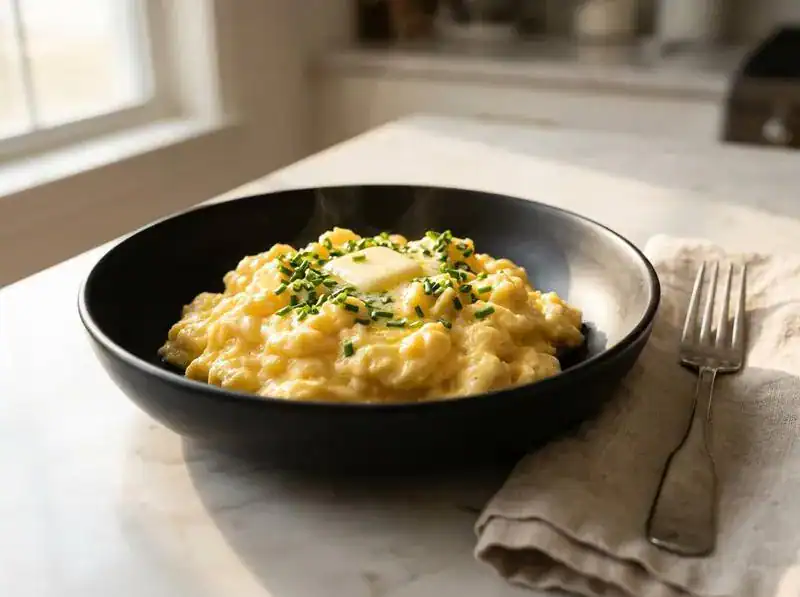
Fluffy Scrambled Eggs: 5 Secrets Restaurants Don’t Want You to Know
Forget everything you thought you knew about scrambled eggs. Most home cooks crack eggs into a hot pan, stir until they’re dry, and serve something closer to rubber than breakfast. However, restaurant scrambled eggs — the kind that slide onto your plate in soft, creamy folds — follow a completely different set of rules.
The good news? None of these rules are difficult. In fact, you need no special equipment, no culinary school, and no expensive ingredients. You only need five small changes to your technique. As a result, these changes transform scrambled eggs from forgettable to the best thing on your plate.
So let’s break down each secret, why it works, and exactly how to use it tomorrow morning.
Secret 1: Cook Your Scrambled Eggs on Low Heat
High heat is the number one enemy of fluffy scrambled eggs.
Here’s why: when eggs hit a very hot pan, the proteins tighten instantly. Because of this, the water inside the egg evaporates before the curds can set gently. As a result, you get dry, bouncy chunks instead of soft folds.
For this reason, professional kitchens cook scrambled eggs low and slow — often over medium-low or even low heat.
The method is simple. First, preheat your non-stick pan over medium heat for one minute. Then, drop the heat to medium-low before the eggs go in. After that, the eggs should set slowly, forming large, soft curds you can push across the pan with a spatula.
Above all, patience pays off here. A batch of scrambled eggs cooked properly takes 5 to 7 minutes, not 2. In other words, those extra minutes are the difference between cafeteria eggs and hotel-brunch eggs.
Secret 2: Fat First — Butter Beats Oil for Scrambled Eggs
Fat does two jobs in the pan. On one hand, it prevents sticking. On the other hand, it coats the egg proteins so they can’t bind together too tightly. Tightly-bound proteins equal tough, watery eggs.
So which fat should you choose? Butter wins every time. Not only does it add flavor oil can’t match, but its milk solids also help the eggs turn a beautiful pale yellow.
Use about one tablespoon of butter for every three eggs. Let it melt over your medium-low heat until it foams but hasn’t browned yet — that’s the exact moment to add your beaten eggs.
Want extra richness? Then swap one tablespoon of butter for a small splash of heavy cream in the egg mixture. Alternatively, do what French chefs do and finish with a knob of cold butter stirred in off the heat.
Secret 3: The Egg Beating Technique Most People Get Wrong
You’ve probably beaten your eggs until they’re completely uniform — fully yellow, zero streaks. Well, stop doing that.
Why? Over-beating mixes in too much air too early. Consequently, the eggs puff up in the pan, then collapse into a dense, watery layer. Instead, slightly under-beating is the pro move.
To do it right, crack your eggs into a bowl and beat them with a fork just until the yolks and whites combine — about 15 to 20 seconds. Don’t worry: a few streaks of white remaining is perfectly fine, even desirable. In fact, these streaks create varied curd sizes and a more interesting texture in the finished eggs.
One more detail: add a pinch of salt to the raw eggs. Old kitchen wisdom says salting early makes eggs watery. However, modern food science has proven this wrong — salt actually helps egg proteins bond more loosely, which means more tender scrambled eggs. So salt early, cook slow.
Secret 4: The Stirring Method That Creates Big Soft Curds
How you move the eggs in the pan determines the final texture. For example, stir constantly with a whisk and you’ll get tiny, uniform curds — fine, but flat and dense.
If you want large, fluffy curds instead, use a silicone spatula and a gentle push-and-fold motion:
- First, let the eggs sit undisturbed for the first 20 seconds after they hit the pan.
- Next, push the set edges toward the center, tilting the pan so uncooked egg flows into the empty space.
- Then repeat every 20 to 30 seconds, keeping the curds large and soft.
- Finally, remove the pan from heat when the eggs look about 90% set — glossy and slightly wet.
Why pull them early? Because they’ll finish cooking from leftover heat in the pan and on the plate. Notably, this is the single biggest trick restaurants use. Pulling the eggs early feels wrong the first time, but trust the process. After all, overcooked scrambled eggs can’t be undone.
Secret 5: Serve Scrambled Eggs Immediately (and the Holding Trick)
Scrambled eggs are at their absolute peak the second they leave the pan. Unfortunately, every minute they sit, they keep cooking and releasing moisture onto the plate.
However, if you’re cooking for a crowd and need to hold scrambled eggs, you have two options:
The warm plate method: Run your serving plates under hot water for a minute, dry them, then plate the eggs. As a result, the leftover heat keeps them creamy without overcooking.
The low oven method: Transfer slightly underdone eggs to a buttered oven-safe dish, cover loosely with foil, and hold in a 200°F (95°C) oven for up to 20 minutes. This way, they’ll stay soft without drying out.
What should you never do? Leave them in the hot pan. Even off the burner, the pan’s leftover heat keeps cooking the eggs into rubber.
Common Scrambled Eggs Mistakes to Avoid
Even with the secrets above, a few habits can quietly ruin your breakfast:
Using a too-small pan. Crowded eggs steam instead of set. Therefore, use a 10-inch pan for 3 to 4 eggs, a 12-inch for 6 to 8.
Adding milk to stretch the eggs. Milk waters down the flavor and adds moisture, which must evaporate before the eggs can set. So if you want creamier eggs, use cream or crème fraîche — a tablespoon at most.
Cracking eggs directly into the pan. Always crack into a bowl first. That way, you can check for shell fragments and beat properly.
Overcrowding the pan with add-ins. Cheese, veggies, and meats release moisture and cool the pan. Instead, cook fillings separately, then fold them in at the end.
Walking away. Scrambled eggs demand your attention for those 5 to 7 minutes. Therefore, stay at the stove, spatula in hand.
Scrambled Eggs FAQ
Why are my scrambled eggs watery?
Watery eggs almost always come from overcooking. In short, as egg proteins cook too much, they squeeze out the moisture they were holding. Therefore, cook on lower heat and pull the pan off the burner while the eggs still look slightly wet.
Should I add milk to scrambled eggs?
No. Milk adds water without adding richness, which works against the fluffy texture you’re after. If you want extra creaminess, stir in a spoonful of heavy cream, sour cream, or cream cheese just before serving.
What’s the best pan for scrambled eggs?
A quality non-stick skillet is the most forgiving choice, especially for beginners. However, well-seasoned cast iron or carbon steel also works beautifully once you’ve mastered the heat control.
Can I make scrambled eggs ahead of time?
You can, although they’re never quite as good as fresh. Simply store cooked scrambled eggs in an airtight container in the fridge for up to 3 days. Then reheat them gently in a buttered pan over low heat with a splash of cream to bring back some moisture.
How many eggs per person for scrambled eggs?
Plan on 2 to 3 eggs per person for a standard serving. However, for big appetites or a brunch spread without many sides, go with 3 to 4.
The Bottom Line
To sum up, fluffy scrambled eggs come down to five things: low heat, real butter, gentle beating, patient stirring, and pulling the pan early. Best of all, none of them cost a dime — they’re pure technique.
So tomorrow morning, give yourself the extra five minutes. Cook them slow, pull them early, and taste the difference. Once you eat scrambled eggs this way, the fast-and-dry version will never tempt you again.
 Cookie settings
Cookie Policy